Banking on Growth: Food, Agriculture and Trade in Greater China
How Rabobank leverages China's strides in innovation and evolving global demand trends to create opportunities for clients worldwide
Could you please introduce yourself and tell us about your journey at Rabobank?
Through my career, I’ve worked for banks across Europe, the US and Hong Kong. Having previously worked at Rabobank in London and New York in the noughties, the move to Hong Kong marked my return to the bank, where I joined as Regional Head of Capital Markets.
About a year after rejoining Rabobank, I was entrusted with leading the Markets business for the whole of Asia. I was asked to become the General Manager of Greater China at the start of 2025. Although this is going to sound like a cliché, rejoining Rabobank did feel like coming home!
We have a very open culture here at Rabobank; we foster collaboration without rigid hierarchies, while encouraging innovation and initiative. For me, that’s one of the best things about working here.
What do you think makes Hong Kong and China important bases for Rabobank and what are some of your key businesses here?
Our presence here is anchored by two major client groups. The first is our large corporate clients that operate along the food and agriculture value chain, forming the nucleus of Rabobank's business internationally. We bank the larger clients in those industries across the Greater China area, as well as in South Korea.
Our second main business is trade and commodity finance, where we finance traders who operate in the agriculture sphere, but also in the metals and energy sectors.
Over the past three decades, China's rapid economic growth has really changed the dynamics of the world economy. In particular, food and agriculture has made huge strides, forming a growth engine for the Chinese economy, and our knowledge and expertise in that sector make us a perfect match for our clients there. China's share of the world economy has grown dramatically over the last three decades to around 19%, driving a substantial increase in demand. The Chinese population is also getting more affluent and moving into the middle class, which means they have more disposable income. Consequently, all these factors drive demand and bring huge opportunities for us.
That demand has continuously accelerated the development of innovation in China and there is great potential for the technology China is bringing to the world. China is also making huge strides in the ag tech sector, which helps our food and agriculture clients globally.
There is huge growth across Asia, particularly in Greater China. Everyone talks about China’s slowdown, but the country is still growing at 4.5% annually. That's more than pretty much every Western economy. To illustrate this scale in numbers, China’s per-annum growth is equivalent to the entire GDP of Switzerland. That shows how big the opportunities are for China to continue playing a major role on the world economic stage.
Rabobank complements China’s potential and tech advancements with our extensive international network across other continents of the world. We have clients that import from South America, Australia and North America, and we have a large presence in all of those geographies. It’s really important that we can connect our clients here in Greater China with those clients around the world.
How does Rabobank see the Greater Bay Area (“GBA”) shaping opportunities for food, agriculture, and trade?
The GBA is renowned for its high-tech environment, manufacturing and innovation, particularly around EVs and renewables. This means there is a high demand in the GBA for base metals like copper, lithium and nickel.
The metals industry is becoming very important to the Hong Kong government and economy. The London Metal Exchange, renowned for being the main trading environment for metals globally, has now categorised Hong Kong as a delivery point, so metals can be stored here in LME-registered warehouses. This is a perfect example of how Hong Kong is trying to drive growth in other industries, especially capitalising on its role as a gateway to China.
As an LME delivery point, Hong Kong has an opportunity to accelerate and expand into the GBA area, to leverage the fact it is now a recognised storage city, so logistics and delivery and other adjacent industries will benefit from that as well.
In your first year as General Manager, what have been the biggest challenges and what are your priorities for the next few years?
2025 was a pivotal year of transition for our Greater China business, which spans our offices in Hong Kong and Shanghai. After integrating more closely with our head office in Europe, we refined our business model and implemented a reorganisation programme. Such transformation initiatives often require leaders to make difficult decisions, but they ultimately strengthen the organisation. The reorganisation has positioned our business to be more sustainable and resilient, enabling us to focus on growth and keep our clients at the core of all we do.
Growing the business with a much more solid foundation is pivotal to my role as General Manager of Greater China. In order to do that, our Global Connector Strategy is at the heart of this. Under this, we link our Hong Kong and China clients with our global network and food & agriculture expertise, where we facilitate introductions into our businesses in South America, Australia, New Zealand, North America and Europe; areas where clients either already have subsidiaries or are looking to set up businesses, or simply to trade with other parties in those countries and continents. We also aim to be the conduit for our European or North American clients looking to establish a presence here in Greater China.
As the title sponsor of the Herring Party, what makes this event a valuable opportunity for Rabobank to connect with the Dutch Business Community?
Rabobank has proudly sponsored the Herring Party since 2015, and even from my first experience, it became really obvious to me why it's such a popular event. It’s actually my favourite event to attend! It's unique and resonates very much as a quintessentially Dutch tradition as well. The setting is fantastic – who can argue with a stunning backdrop of Victoria Harbour at the Yacht Club? The herring party truly is a unique experience that allows us and our clients a chance to connect meaningfully with the Dutch community in Hong Kong.
As a Dutch bank, maintaining and deepening these connections with the Dutch community in the city is invaluable. Each year, the event brings together clients, partners, old friends and new. It’s always a night of creating connections and solidifying those relationships.
I think Dutch Chamber members also look forward to the herring party every single year, so it’s a huge privilege for us to be a part of the magic too. The relationship we share with the Dutch Chamber and the Dutch community is so important to us, and it helps to strengthen our presence in Hong Kong. We lost a little bit of this personal touch a few years ago during COVID, but we have a lot of support from our head office to deepen our involvement moving forward. Coming onto the board of directors of the Dutch Chamber means I get to directly contribute to the agenda of the Dutch Chamber in Hong Kong, and that's been really well received at our head office, given the importance we place on our Dutch heritage.
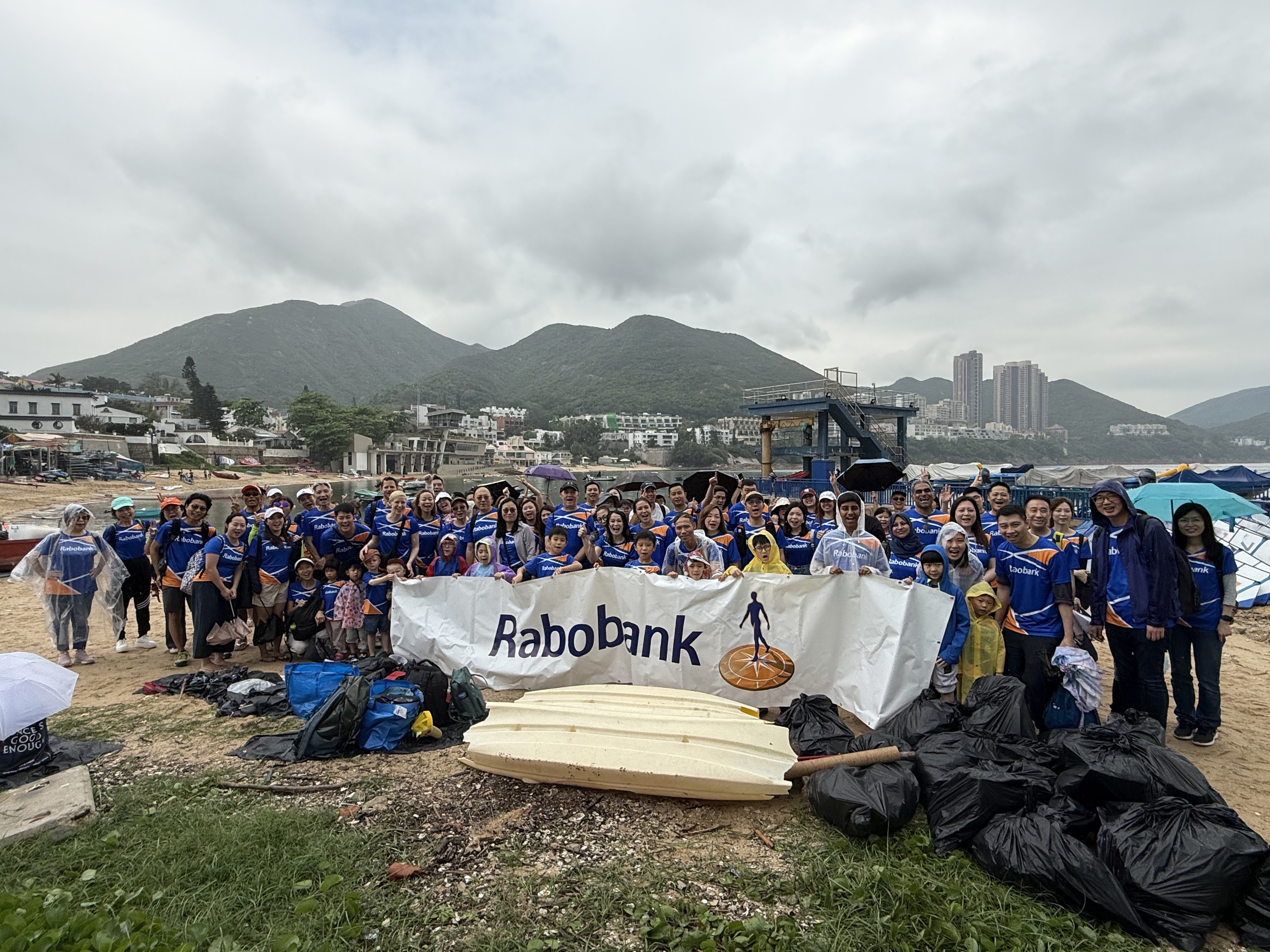
Ian leads Rabobank Hong Kong colleagues in a coastal clean-up at the city’s Stanley Beach